
Which defense are you using?
The overlay lists three separate defensive inputs. They do different jobs.
Head guard and body guard are not two settings on one slider — they are two different commitments, and one of them leaves a hole.
| Head covered | Body covered | The hole | |
|---|---|---|---|
Style guard (F / L-Shift) |
Yes, as far as your style catches | Partly, style dependent | Whatever your style does not catch |
Head movement (Space + direction) |
No — you move the head instead | No | If you read the punch wrong, nothing is blocking |
Body block (G, RT+LT, BODY) |
No | Yes, all body shots while held | Your head is fully open |
The practical rule: body block is the only one of the three that actively exposes a target. Hold it when the punches are going low, and expect a level change the moment you drop your hands.
The overlay also notes that any key can be rebound, so check Settings > Keybinds before assuming your guard is on F.
Catch windows and block counters
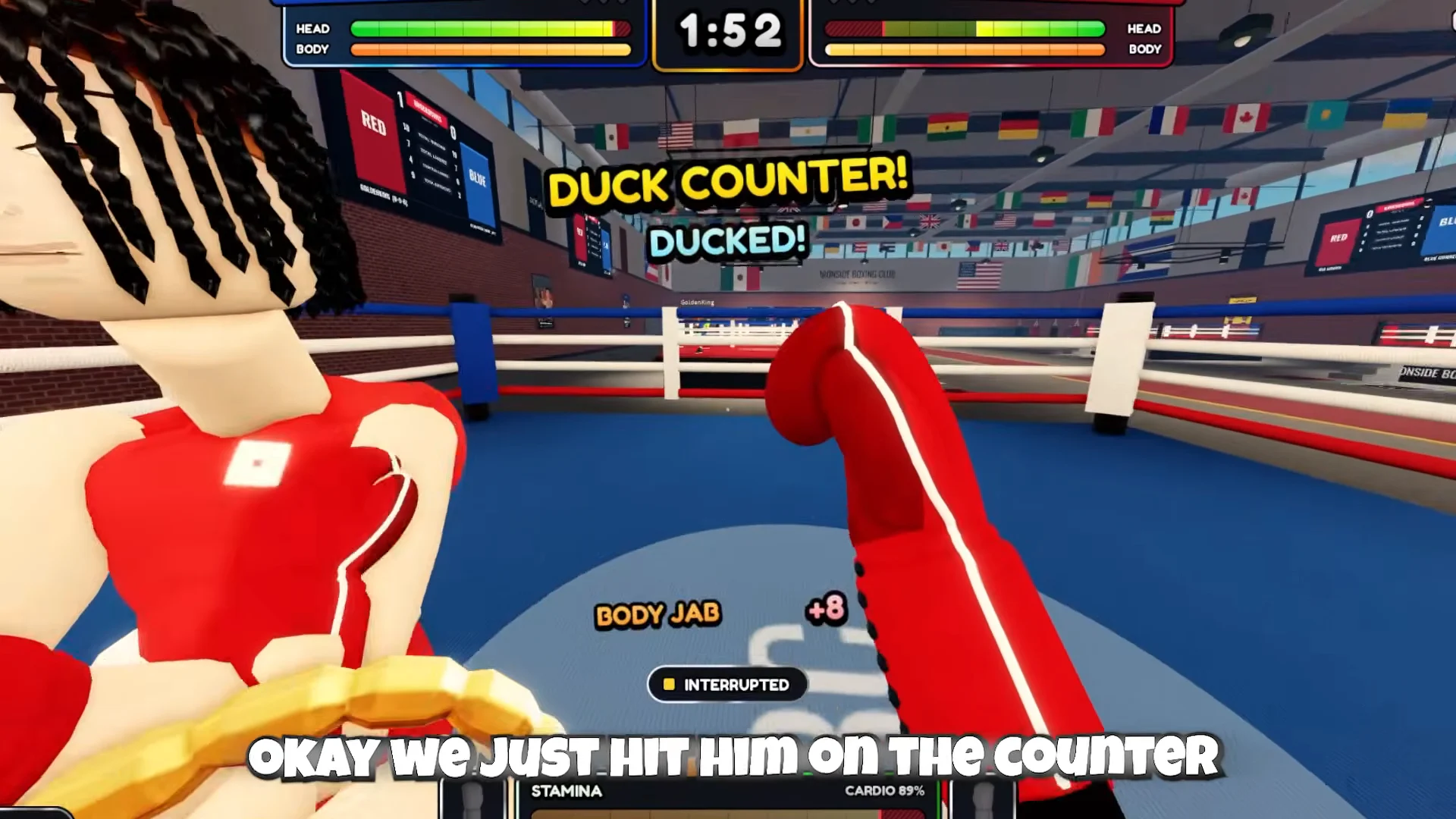
Two things were published on 20 October that change how defence converts into damage.
First, the patch states that every catch style — Philly, Slick, Parry, Long Guard, Hitman, Karate, Muay Thai and Soviet — now opens a counter window when it catches a punch. Before that, catching was mostly damage reduction; now it starts an opening.
Second, two styles add a different route: Crossarm walling off a straight or uppercut now fires a BLOCK COUNTER, and The Finisher does the same after walling off power shots. So "block counter" and "catch counter" are not the same trigger, and a style may have one and not the other.
What you actually press after the catch is the same punch input you use in any exchange — this build could not capture that row of the controls overlay, so rather than print a guess the inputs are listed on the controls page. Read them from your own overlay with H before you try to convert a catch into a counter.
One caution about the on-screen text. The captured footage shows DUCK COUNTER! and DUCKED! after an exchange, which confirms result text exists. It does not show a prompt appearing before the hit, and guidance that tells you to wait for a specific pre-hit prompt is not supported by this material — player reports describe two different strings for it. Use the exchange outcome, not a remembered prompt.
When to hold body block
Body block arrived on 21 October. Hold G on PC, hold RT + LT on a controller, or hold the BODY button on mobile. While held it stops body shots; on mobile, releasing returns you to whatever guard you had toggled.
The trade is the point: your head is fully open while you hold it. If your opponent switches upstairs, holding body block is worse than doing nothing. Watch where the punches are landing before you commit, and expect a competent opponent to change levels the moment you drop your hands.
Alternate hands instead of inventing a punch limit
The 20 October patch is explicit about combinations, and it is a comparison rather than a rule of thumb.
| What you throw | Result according to the patch |
|---|---|
| Back the other way off your last shot | Lands harder and faster, for less stamina |
| The same hand again | A weak arm punch |
| Head then body, in rhythm | Harder to auto-defend |
| Body then head, in rhythm | Harder to auto-defend |
A common piece of advice says a specific number of punches is "safe" and the next one gets you countered. No such limit is published.
That contradicts a common piece of advice that a specific number of punches is "safe" and the next one gets you countered. No such limit is published. What is published is an economic argument: repeating one hand costs more and lands weaker, so the third punch in a row is not dangerous because of a hidden counter rule — it is dangerous because it is a tired, weak punch that leaves you committed.
The same patch cut how fast permanent damage builds, to about half its previous rate, so fights stay closer into the later rounds. If your knockouts used to arrive early, they may now arrive later with both fighters still dangerous.
If the knockout still looks wrong
A knockout is not self-explanatory, and a single clip is usually enough to tell which of these it was.
| What you saw | What to check | What to change or record |
|---|---|---|
| You held body block and got hit in the head | Whether you kept holding it after the punch moved upstairs | Next match, note whether you released when the target changed |
| You were knocked down at what looked like half health | How much of the damage came from one clean counter | Record the round and watch the replay, which shows the punch that landed |
| You caught a punch and still lost the exchange | Whether your style has a catch window, a block counter, or neither | Check the style's row on the styles page |
| Your opponent looked like they were at zero and kept fighting | Whether they had just been knocked down | The 17 October patch states a knocked-down fighter returns with at least a third of their health |
The patch that brought that last rule also made punches from behind do far less damage and unable to knock you down, so "I was hit from behind" no longer explains a knockout by itself.
If the same thing repeats after you have checked these, stop diagnosing from memory. Record the fight and send it through the feedback mailbox in the gym.